

posted 22nd September 2026
At a time when platforms such as Google Translate, DeepL and other machine-translation tools allow us to communicate across languages almost instantly, questioning their usefulness may seem almost pointless. They have transformed the translation market, making it possible to translate large amounts of text in seconds.
The arrival of large language models such as ChatGPT and Gemini has taken this development a step further. These systems do not merely translate sentences. They can rewrite, summarise, explain and adapt texts, often producing remarkably fluent results.
For everyday communication, this is undoubtedly useful. If we want to understand a message, read a website or grasp the general meaning of an unfamiliar text, these tools can often do the job surprisingly well.
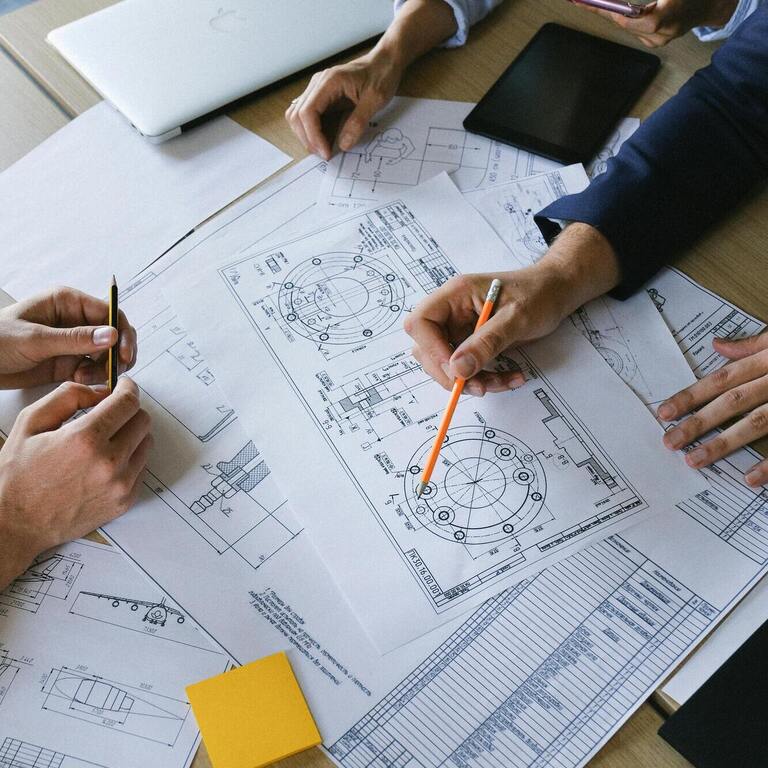
But what happens when the text is not ordinary? What happens when it is an engineering specification, an architectural report, a tender document, a technical manual or a set of contractual requirements? This is where the problem becomes more complicated.
The problem with technical language
Languages are not collections of words with fixed meanings. The meaning of a word depends on the context in which it is used, and technical disciplines add another layer of complexity. Take the English word bearing. Depending on the context, it can refer to a mechanical component, the orientation of an object, or the way in which something is positioned or supported. The same problem occurs with words such as load, stress, plant and commissioning.
A translation system must therefore do more than identify a likely equivalent for a word. It must determine what that word means in the particular document and, more importantly, whether that meaning is the one required by the discipline in question.
This is not merely a theoretical problem. Research into neural machine translation has shown that domain-specific terminology remains a particular difficulty for machine-translation systems. In a 2023 study, Prashanth Nayak and his colleagues found that, although state-of-the-art neural machine-translation systems can produce high-quality translations, they do not consistently achieve the same level of accuracy with domain-specific terms. Their experiments also showed that adapting a system to the terminology of a particular domain can significantly improve the translation of multi-word terms.
Terminology matters particularly in engineering and architecture because it is not simply descriptive. It carries information.
A technical term can identify a component, define a process, establish a performance requirement or distinguish one construction method from another. Choosing the wrong equivalent may therefore alter the meaning of a document while leaving the resulting sentence perfectly grammatical. And this leads to another problem.
The danger of fluent errors
Older machine-translation systems had one advantage: when they made mistakes, those mistakes were often obvious. The sentences sounded strange. The grammar was awkward. The reader could see that something had gone wrong.
Modern systems are different. Their output can be remarkably fluent. A sentence may look as though it was written by a competent human translator even when the information it contains is inaccurate.
This phenomenon has been examined in recent research. In a large study covering more than 100 language pairs, Nuno M. Guerreiro and his co-authors investigated hallucinations in neural machine-translation systems and large language models, including GPT-based systems. They found that such systems can produce translations that become detached from the source, including cases in which information is added or the meaning of the original is otherwise distorted.
The point is not that machine translation always produces such errors. It does not. The point is that fluency cannot be treated as evidence of accuracy. This distinction becomes particularly important when translating technical material. An incorrect sentence in an informal email may cause confusion. An incorrect technical requirement, specification or measurement can have consequences much further down the line.
The better a system becomes at producing convincing prose, the less visible some of its mistakes may become.

But does this mean that artificial intelligence cannot translate technical texts?
No. That would be an equally misleading conclusion.
Machine translation has improved enormously, and it would be difficult to imagine professional translation today without some form of computer-assisted technology. The question is not whether these tools are useful. They clearly are. The question is what we expect them to do.
A machine-translation system can provide a first draft. A large language model can suggest alternative formulations, identify repetitions, compare passages or help a translator work through a difficult section. But producing a plausible translation and determining whether that translation is correct are two different things. This distinction is particularly important in specialised translation.
Translation requires knowledge
A technical translator does not work with language alone. To translate an engineering or architectural document properly, the translator needs to understand what the document is about. This does not necessarily mean being a practising engineer or architect. It does mean possessing enough knowledge of the subject to recognise its concepts, terminology and conventions.
Research into translation competence supports this broader view of the profession. Krisztina Károly’s work on specialised translation, for example, treats translation competence as a combination of several forms of knowledge rather than simply linguistic proficiency. These include linguistic, intercultural, professional and domain-related competences.
There is a practical reason for this. Imagine that a translator encounters a technical term for which two possible equivalents exist. One is common in general language; the other is the established term used by engineers in the target country.
Which one should be chosen? The answer cannot necessarily be found by determining which word is statistically more probable. It may require consultation of technical standards, previous project documentation, specialist dictionaries or parallel texts. It may even require asking the client what was intended. This is one of the differences between translation and text generation.

Human expertise still has a role
There is an interesting lesson in research comparing professionals working with machine-generated technical translations. Özlem Temizöz studied the post-editing of an English-to-Turkish technical text translated using Google Translate, comparing the work of professional translators with that of engineers. Both groups achieved similar results in several categories, while the engineers performed significantly better in terminology.
The study is useful precisely because it complicates the argument. It does not show that engineers are necessarily better translators. Nor does it show that translators can work without subject knowledge. What it does demonstrate is that technical translation involves both linguistic and subject-matter competence.
The best solution is therefore unlikely to be found in choosing between technology and human expertise as though they were mutually exclusive.
Engineering documents are part of larger systems
There is another reason why technical translation cannot always be reduced to translating one sentence at a time. Engineering and architectural documents rarely exist in isolation.
A specification may refer to a drawing. A report may refer to calculations contained elsewhere. A tender document may use terminology that must remain consistent across hundreds of pages. A technical manual may need to correspond exactly to the terminology used in a BIM model or a set of contractual documents.
The translator must therefore understand not only the sentence but its place within the document and, sometimes, within the entire project. This is particularly important when translating into different varieties of the same language.
English-language engineering documentation intended for Portugal, for example, cannot automatically be treated as though it were intended for Brazil. The two varieties of Portuguese share the same language, but technical terminology, institutional conventions and professional usage may differ.
A translation can therefore be grammatically impeccable and still be inappropriate for the project.
So where does this leave us?
The answer is not to reject artificial intelligence. On the contrary, these technologies are valuable tools. They can accelerate routine work, provide useful drafts and help translators process large volumes of material. But they should not be confused with technical expertise.
A machine can suggest that two words are equivalent. A specialist can determine whether they actually are. A language model can produce a fluent paragraph. A translator can compare it with the source and ask whether anything has been omitted, added or misunderstood. A machine can recognise patterns in language. A human specialist can investigate why a particular term was used, how it functions within the project and whether it conforms to the terminology expected by the people who will ultimately use the document. That distinction matters.
Engineering and architectural translation is not simply about moving words from one language to another. It is about transferring technical information accurately from one professional context to another.
For straightforward communication, automated translation may often be enough. For documents on which designs, projects, contracts and decisions depend, however, there is still a place for someone who understands both the language and the subject.
That is not a rejection of technology. It is an acknowledgement of what technology can — and cannot — do.